The Lighthouse That Ate His Name
The Lighthouse That Ate His Name
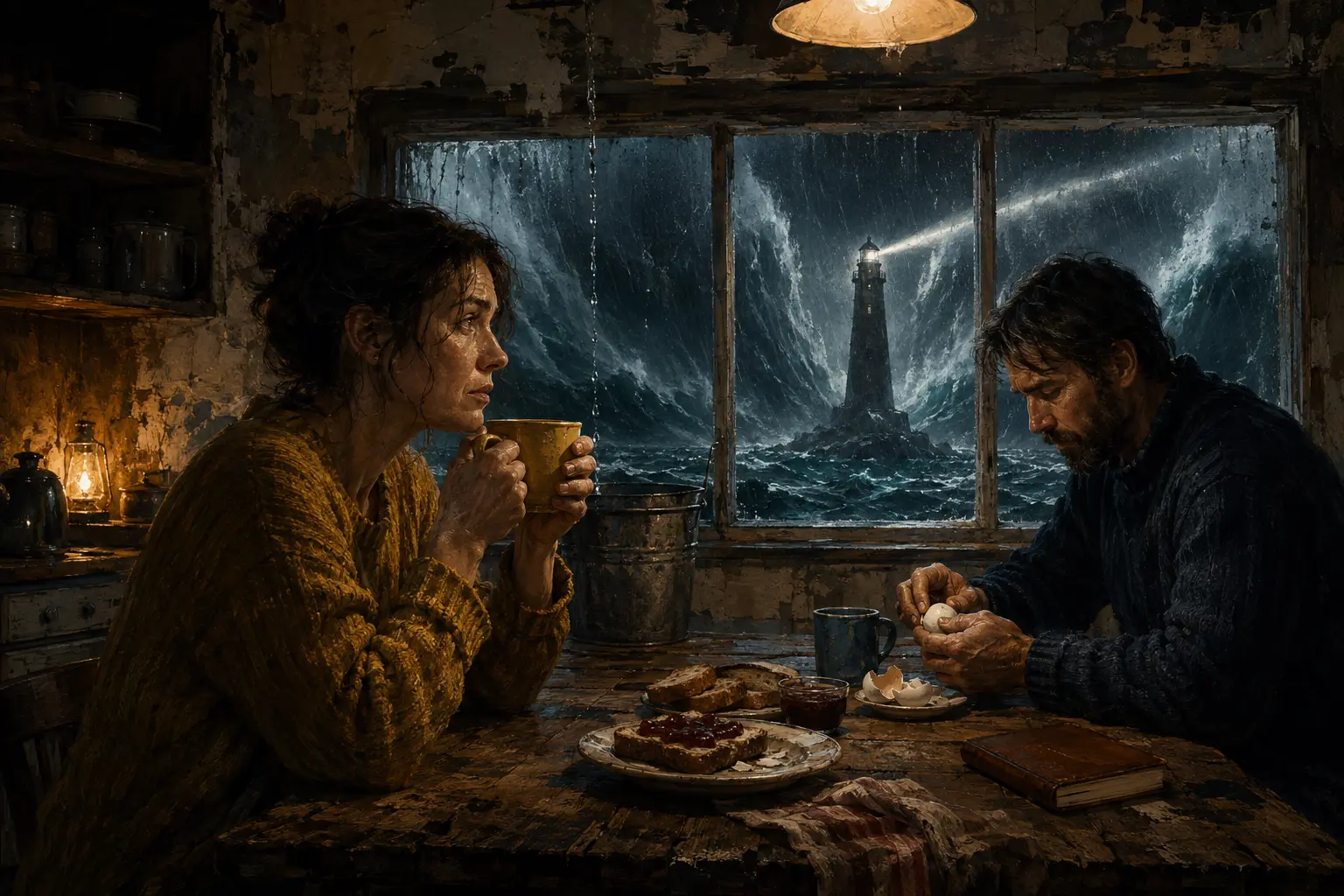
The warning sirens began while Iven was losing a fight with an egg.
He had cracked the shell in twelve places and removed almost none of it. Each time he pinched at a loose edge, a wet piece of white came away underneath. By the time the first siren rolled across Bellwether, the egg looked small and diseased in his hand.
Mara watched from the sink. “You teach eleven-year-olds how to calculate tidal force.”
“Tides are consistent.”
“The shell is right there.”
“It changes strategy.”
The second siren sounded. It came from the harbor wall first, then the courthouse, then the eastern wards, where the towers repeated it half a note too low. Three long blasts. A pause. Three more.
Iven set the egg down.
On the sill above the sink, their little brass weather wheel spun from blue to white. White meant a storm beyond the ordinary wall schedule. Red meant the water was already inside.
“Maybe they’re testing it,” he said.
Mara dried her hands. “They test on Saturdays.”
It was Tuesday.
The wall speaker crackled. A woman from Civil Water read the announcement twice in the same flat voice.
The Ninth Tide had crossed the western gauges at 4:12 that morning. The deep buoys had failed to predict its turn. Landfall was expected in thirty-one hours. All residents were to report to their ward stations before noon and prepare for vertical shelter.
The woman stopped speaking. Somewhere in the building, a baby began to cry.
Iven picked up the ruined egg and held it under the tap.
“That won’t put the white back,” Mara said.
“I know.”
He was still holding it when water came through the kitchen ceiling.
One drop struck his wrist. Another landed on the table between the salt cellar and the blue cup. Their roof leaked in five places, but never over the table. Iven looked up as if the plaster had spoken to him.
“Six,” he said.
Mara got the bucket from beneath the sink.
They had planned to fix the roof in autumn. They had planned to do many things in autumn.
Bellwether had survived eight black tides in a hundred and fourteen years.
The storms did not resemble ordinary weather. They traveled against prevailing wind, bent around warm currents, and arrived with a pressure that made dogs bite doorframes. No one agreed on why. The Temple said the sea remembered every wall raised against it. The university blamed heat below the northern shelf. Drunk people blamed whichever island had won the regatta that year.
The city survived because of the lighthouse.
From the old seawall, it looked like a black needle driven into the island’s eastern cliff. The lamp at its crown could separate a black tide into ordinary wind and water, provided a human mind sat inside the lens and gave it something complex enough to burn.
The first keepers offered childhood songs, the faces of the dead, and the routes they walked home from school. The storms consumed those memories in minutes. Later keepers learned to offer everything at once.
The city called them witnesses.
They woke afterward knowing language, balance, hunger, shame, and how to use a spoon. They could play instruments if their hands had practiced long enough. They could not name their parents. They did not recognize their own children.
Bellwether gave each witness a white apartment on the hill, a pension, and a new legal birthday.
Mara repaired the small relay clocks that synchronized the lighthouse lens with the harbor wall. She had visited the tower once a month for eleven years. She knew which stair complained in damp weather and which copper panel required a knee against it before the latch would close. She had never gone into the chair room.
At nine that morning, a courier in a yellow storm cape knocked on their door.
He did not ask for Mara.
“Iven Saye?”
Iven had put on his gray school coat. He stood in the hall with one boot unlaced.
“Yes.”
The courier checked the photograph on his slate. “The council requires you at the lighthouse annex. Transport is waiting.”
Mara turned to her husband.
He bent to tie his boot.
“Why?” she asked.
“They’ll be calling anyone with school shelter training.”
The courier looked at the floor.
Iven pulled the knot tight. “Mara.”
She understood before he told her. Understanding arrived as heat in her face, followed by a clean emptiness that made every object in the hall look newly placed. His scarf on the hook. The wet toe of his boot. A green tile on the windowsill, chipped at one corner, which he had carried home from their trip inland because it was the exact color he wanted for the kitchen they would build.
“How long have you been on the list?”
The courier stepped backward into the stairwell.
Iven stood.
“Nine weeks,” he said.
Nine weeks contained a trip to the north orchard, three dinners with her sister, a night at the cheap hotel by the rail station, and thirty-seven pages of sketches for the inland house. Seven windows, according to Iven. Six, according to any person who had ever paid for glass.
Nine weeks ago, he had begun asking her questions in bed.
Which song did her father hum when he sharpened a knife? What did she buy with the first money she earned? Had the dog they owned as children been brown, or did she remember him as brown because every photograph had yellowed?
She had thought forty was making him sentimental.
“You made an inventory,” she said.
“I wanted to remember it accurately.”
“Until you didn’t.”
The weather wheel clicked behind them. White to white. It had nowhere worse to go except red.
Iven reached for her hand. Mara put both hands in her coat pockets.
“You should come,” he said. “There are things they need to explain.”
“I know what the lighthouse does.”
“There are things I need to explain.”
“You’ve had nine weeks.”
The courier waited one flight below, pretending to study the rain.
Mara took the green tile from the sill and put it in her pocket. Then she followed her husband downstairs.
The annex had been built for families who needed to be angry in private.
Its rooms were thick-walled and almost empty. A couch. A pitcher of water. A box of gray paper handkerchiefs that turned to paste against wet skin. On one wall, somebody had hung a painting of the harbor on a calm day. The painter had left out the lighthouse.
Councilor Venn came in with a lens physician and two pages of consent forms. She was no relation to Mara, though strangers had been asking them for twenty years. Today neither woman made the usual joke.
“The lens selected four compatible candidates from the voluntary register,” the physician said. “Mr. Saye’s retention profile gives us the highest probability of a full division before landfall.”
“How high?” Mara asked.
“Eighty-two percent.”
“And the others?”
“Sixty-one. Fifty-eight. Forty-four.”
“Use all four.”
Councilor Venn folded her hands. “The lens cannot combine autobiographical patterns. Interference would collapse the beam.”
“Then use the sixty-one.”
The physician looked at Iven.
Mara knew that look. She had used it herself when customers demanded a repair that would leave a clock worse than they brought it in. The look said the objection had been anticipated and placed in the correct column.
“At sixty-one percent,” the physician said, “we expect the eastern wall to fail before the tide divides.”
“Expect.”
“Yes.”
“How many people?”
“The eastern and mill wards have a combined night population of forty-three thousand. Evacuation uphill will reduce exposure. We cannot predict by how much.”
Iven sat beside Mara. Their knees touched. She moved hers away.
The forms were already signed.
She recognized his handwriting at the bottom, the long tail on the y in Saye, the little pause where his pen always caught on cheap paper.
“I can stop it,” she said.
The councilor did not answer.
Mara looked at the physician. “The mercury bypass behind the east relay. I pull it, the chair can’t lock.”
“The lens can be fired manually.”
“Not at full division.”
“No.”
Iven leaned forward. “They asked you here because the clocks have to be reset after the first surge.”
“They asked me here so I won’t pull the bypass.”
No one corrected her.
Rain struck the high window in handfuls.
Councilor Venn slid the forms into a leather case. “You have until midnight. The chair sequence begins at 12:20. Mr. Saye may spend the remaining time anywhere inside the lighthouse grounds.”
“How generous,” Mara said.
The councilor took that without moving.
When they were alone, Iven poured a glass of water and drank half of it.
“My mother was in the eastern ward,” he said.
“I know where your mother was.”
“And Pell.”
“I know.”
Iven had been nine when the Eighth Tide broke three city blocks before a witness entered the lens. His mother and his brother died in the top room of a boardinghouse, high enough to be safe from any water the old maps predicted.
Every year on the anniversary, Iven cooked his mother’s bean stew. He hated beans. Mara ate two bowls and never mentioned this.
“I’ve had thirty-one years that they didn’t,” he said.
“So they get to spend mine?”
His face changed.
She wanted the sentence back. She also wanted him to hurt.
“We were leaving,” she said. “Sixteen days. The rail tickets are in the blue drawer.”
“I know.”
“We put a deposit on the shop.”
“I know.”
“You wrote to the orchard about apricot trees.”
“Two trees. They said we need two for pollination.”
“You don’t get to remember that now.”
He pressed his hands together between his knees.
“I thought the city would call someone else,” he said.
“You volunteered because you thought they wouldn’t pick you?”
“I volunteered because I knew they might.”
There it was: a sentence with no loose edge. Mara could not get a nail under it.
She stood and crossed to the calm-harbor painting. Up close, the water was made of short green marks. The artist had painted eleven gulls, each a white check in the sky.
“If you die,” she said, “people bring food. They tell stories. They stop asking you to make decisions after a year or two.”
“I’m not dying.”
“You’ll wake up and everyone will be thrilled. They’ll give you an apartment. I can visit the apartment and explain that you used to leave wet towels on the bed. If I’m patient enough, maybe I can teach you to laugh at the same places.”
“You don’t have to.”
She turned.
He was crying without sound. He wiped his face with the heel of his hand and looked embarrassed by the mess.
“Don’t make me good after this,” she said.
“I won’t.”
“Don’t leave a letter telling me to live.”
“All right.”
“Don’t tell whoever wakes up that he belongs to me.”
Iven nodded.
“And don’t ask me to forgive you before midnight.”
He looked down at his hands.
“All right,” he said again.
They spent the afternoon in the lighthouse kitchen.
The city had stocked it for a siege: flour, hard cheese, onions, preserved lemons, a sack of coffee, and enough dried fish to make the cupboards smell permanently of low tide. Iven found a jar of red jam behind the tea tins.
“This expired six years ago.”
“Sugar doesn’t expire.”
“The label says it did.”
“The label lacks courage.”
Mara hated herself for laughing. It escaped before she could decide whether he deserved it.
Iven smiled, then covered the smile with his hand.
“Sorry.”
“Don’t.”
They made toast on the iron stove. The jam had darkened to the color of old blood and tasted faintly of metal. Mara ate a second piece.
Outside, ward bells sent people uphill. From the kitchen window they watched families climb the cliff road under sheets of rain. Everyone carried the wrong things. Framed photographs. Bed pillows. A copper pan. One man pushed a broken sewing machine in a pram.
Iven took a notebook from his coat.
It was the brown one he had carried for nine weeks. Mara had seen him write in it at dinner, on the train, once in the bath.
He put it on the table between them.
“I didn’t write you instructions,” he said.
She opened the cover.
The first page read: Things I am afraid I invented.
Beneath it, in Iven’s cramped hand:
Mara says her father could peel an orange in one piece. I have never seen evidence.
Pell once bit through his own lip because I told him laughing with food in his mouth would make soup come out of his nose. He was eating bread.
My mother’s stew may have used white beans. I buy red because Mara likes them better.
Mara closed the book.
“Why would you write down things you’re afraid you invented?”
“Because I wanted to know which parts were mine.”
“They’re all yours.”
“Even the wrong ones?”
“Especially those.”
He turned the cup by its handle.
“There’s no copy of me in there,” he said. “I started one. Favorite foods, people’s birthdays, the story about how we met. It read like notes for an examination. I threw it in the stove.”
Mara rested her palm on the notebook.
The lighthouse shuddered as a wave struck the cliff below. Flour sifted from a crack in the ceiling.
“Tell me how we met,” Iven said.
“You know how we met.”
“I want to hear your version.”
She almost refused. Then she told him.
She told him about the clock he brought to her first shop, a brass alarm clock with a bell loud enough to wake the dead. Iven claimed it had belonged to his grandmother. Mara found the maker’s stamp and proved the clock was six years younger than he was. He admitted he had bought it from a pawn stall because the woman repairing clocks was pretty and he needed an excuse.
“I said your eyes were kind,” he said.
“You said I had a trustworthy forehead.”
“That sounds worse.”
“It was worse.”
She kept the clock. It sat on the shelf above their bed and went off at 6:10 every morning because the shutoff pin had snapped years ago.
“The shop inland has a front room and a back room,” Iven said. “We could still afford it on your income if you rented the back.”
Mara looked at him.
“I am trying to discuss rent with the man who stole my life.”
“Our life.”
“You gave away your half. Mine got carried with it.”
He nodded once.
At dusk the physician brought them two bowls of soup. Neither ate. Iven slept for forty minutes with his head on Mara’s lap. She watched rain race sideways across the glass and touched the cowlick above his left ear.
Every haircut began with Iven warning the barber about that cowlick, as if it were armed.
At eight, the city lights went out ward by ward. The lighthouse generator took the load. A low vibration filled the kitchen. The cup handles trembled against their saucers.
At ten, Iven asked if she wanted to play tiles.
They played on the floor because the table had begun to slide with each wave. He won the first game. Mara won the second by cheating. He saw her move a piece and said nothing.
At eleven, they walked the inner gallery.
The storm had covered the sky. Water crossed the lower wall in white bursts and vanished into the streets beyond. From this height, the people sheltering in the university looked like grains of rice behind lit windows.
Iven put both hands on the rail.
“I wish we had left last week,” he said.
Mara waited.
“I wish I had never put my name down. I wish the sixty-one were enough. I wish Pell were here so I could ask whether this is guilt or decency. He’d say guilt because he enjoyed being right.”
The honesty softened something in her that she had been using as a brace.
“I wish you had trusted me with the choice,” she said.
“Would you have let me volunteer?”
“No.”
“That’s why.”
“I know.”
It was the nearest they came to forgiveness.
At midnight, he went to the chair room.
The chair was smaller than Mara expected.
It stood inside the lighthouse lens, surrounded by eight curved plates of mnemonic glass. The plates were clear until Iven sat down. Then color moved through them: brown, green, a brief yellow flare.
Technicians fixed silver contacts behind his ears and at the base of his throat. He wore his gray school coat because he had refused the white gown.
Mara worked at the east relay one floor below. The mercury bypass lay behind a round panel at shoulder height. It was no larger than a door bolt.
Pull the black handle. Break the chair lock. Reduce the beam below division strength.
At 12:17, the physician’s voice came through the speaking tube.
“First surge in three minutes.”
Mara set the clock train to zero. Her hands knew each wheel by weight. She had serviced this relay through two small storms and one false alarm. She fitted the escapement, turned the balance screw, and checked the harbor signal.
Green.
Above her, Iven began to speak.
Witnesses were told to describe a familiar place while the lens opened. It helped the glass find the paths between memories.
“The kitchen is three steps wide,” he said through the tube. “The north cabinet sticks in summer. There is a burn on the table shaped like the island of Moss. Mara says it looks nothing like Moss.”
The tower groaned.
“The blue cup is mine because Mara hates the way the handle pinches her finger. The yellow cup is hers. She says she does not care. She is lying politely.”
Mara looked toward the bypass.
The black handle shook in its housing.
She crossed the relay room and put her hand around it.
Iven continued.
“There is a brass clock above the bed. It rings at 6:10. We could fix it. We don’t.”
The first surge hit.
Every gear in the relay jumped one tooth. Mara’s shoulder struck the wall. In the street below, windows burst inward. The clock mechanism screamed as the harbor wall tried to close against water already on top of it.
The physician shouted numbers through the tube.
The lighthouse lamp came alive. A narrow white beam cut east across the sea.
The black tide rose beyond the wall. It had no single crest. The whole horizon lifted.
Mara pulled the handle halfway.
The relay alarm began to ring.
Forty-three thousand people in the eastern and mill wards. Fewer after evacuation, though no one knew how many. A man pushing a sewing machine in a pram. Her sister and her sister’s two boys in the courthouse shelter. Children from Iven’s school sleeping under laboratory tables uphill.
The handle moved another inch.
Above her, Iven said, “We were going to plant two apricot trees.”
His voice broke on two.
Mara let go.
The bypass slammed home.
She returned to the relay and locked the gear train at full division.
Light filled the tower.
Iven made a sound she had heard once before, when a surgeon reset his wrist without enough ether. The sound lasted less than a second.
Then he went on describing the house.
His voice changed gradually. Proper names disappeared first.
“The woman I live with keeps screws in a tea tin. She thinks I don’t know she eats the burnt ends of bread over the sink.”
The beam widened.
“My brother had a gap between his front teeth. Or I did. There was a red scarf.”
The black tide struck the light and opened.
On the harbor gauges, one impossible wall of water became two ordinary storms. One turned north toward empty sea. The other broke over Bellwether in rain hard enough to strip paint.
“The kitchen is…”
Iven stopped.
The relay clock completed its sequence. Mara held the balance wheel until the last vibration left it.
At 12:31, the physician said, “Division confirmed.”
People began cheering in the university. The sound traveled through broken windows and stone corridors until Mara could hear it below the tower.
She climbed to the chair room.
Iven was awake. The glass around him had gone clear. A technician removed the contact from his throat.
He watched Mara approach with the careful attention people give an unfamiliar dog.
“Hello,” he said.
Bellwether named the eastern school after him before he left the hospital.
His face appeared on the tram shelters. Someone painted him thirty feet high on the mill wall, standing in a calm sea with the lighthouse beam behind his head. The painter gave him a look of stern courage that Mara had never seen him use.
For six weeks, strangers brought food to her apartment. The dishes came with notes about duty, gratitude, and the soul of the city. Mara ate the bread and threw the notes away.
The man who had been Iven chose the name Ren.
The rehabilitation physician said this was a good sign. Witnesses who chose their own names adapted faster than those who accepted one from a list.
Ren remembered how to read. He knew geography, algebra, and the movement of the moons. He could tie a fishing knot and play seven songs on the mandolin. He disliked beans.
He did not know why Mara laughed when the nurse told her that.
She visited every Thursday.
At first she brought the brown notebook. Ren read three pages, then closed it.
“Did I write this?” he asked.
“Yes.”
“It feels like spying.”
Mara put the book back in her bag.
The next Thursday they walked in the hospital garden. Ren stopped beside every plant to read its label. He liked names. He repeated them under his breath: foxglove, salt rose, winter fennel.
“Did I like plants?” he asked.
“You liked the idea of plants. Actual plants found you neglectful.”
He smiled. His smile belonged to Iven so completely that Mara had to sit down.
Ren waited beside her.
“Should I not do that?”
“You can do anything you want.”
“That sounds untrue.”
“It is. People say it when the true answer would take too long.”
He sat at the other end of the bench.
By the fourth month, Ren had an apartment on the hill. White walls, government furniture, three windows facing inland. He enrolled in a cabinetmaking course. The work pleased him because a board stayed where he put it.
Mara had moved to the shop inland alone.
It had six front windows.
She rented the back room to a woman who repaired shoes and swore at customers after they left. The two apricot saplings arrived in a long wooden crate. Mara planted one beside the road and one behind the shop, exactly as the orchard instructed.
One died.
The orchard offered a replacement. She did not answer.
In early spring, Ren sent her a letter asking whether she would meet him at a café near the rail station. He had drawn a map in the margin although Mara knew the city better than he did.
She arrived first.
Ren came in carrying the brown notebook.
“You left this at my apartment,” he said.
“I thought you might want it later.”
“I read the rest.”
Mara took off her gloves one finger at a time.
The café served boiled eggs with breakfast. On the plate in front of her sat two, smooth and white and blameless.
“Was that all right?” she asked.
“I don’t know.”
He placed the notebook between them.
“The man in there loved you.”
“Yes.”
“Everyone keeps telling me I was brave. He doesn’t sound brave.”
“He was frightened of deep water and dental work. He cheated at cards against children.”
“Did you love him?”
Mara looked through the window at the station clock. It was four minutes slow. No one else would notice before evening.
“I still do,” she said.
Ren rubbed his thumb along the notebook’s cloth edge.
“Is there room in that for me?”
She had prepared answers on the train. None had survived the question.
The server brought coffee in two cups, one blue and one yellow. Ren reached for the blue, stopped, and pushed the yellow toward Mara.
“The handle on that one is better,” he said.
Mara put her finger through it. The handle did not pinch.
Ren picked up one of the eggs. He tapped it once against the plate and rolled it beneath his palm. The shell came away in two clean halves.
“You learned,” Mara said.
“Was I bad at this?”
“Terrible.”
He salted the egg and put it on her plate.
“I don’t know if I’m coming next Thursday,” she said.
Ren nodded. “All right.”
Outside, the sea was too far away to hear. The station clock lost another second.