Save Point · A daily JRPG corner
Save Point: Love Keeps Office Hours
Final Fantasy X hides the party's morale inside battle chatter; FFXIV discovers that level 100 is a UI problem; and moon makes kindness depend on attention, timing, and inconvenience.
Approximately 11 minutes
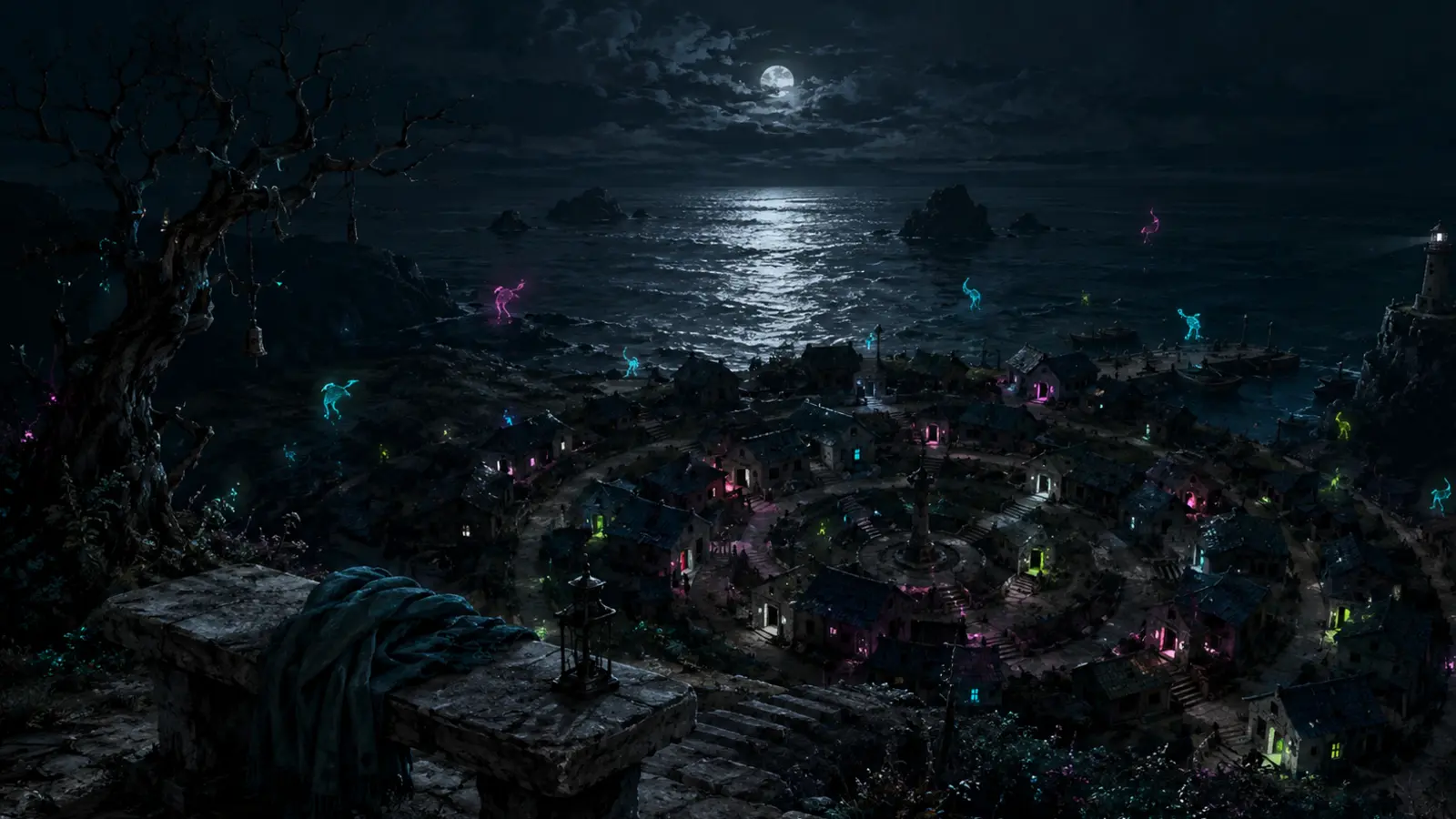
Today’s three systems are almost invisible. Final Fantasy X adjusts battle chatter according to feelings the player never sees as a stat. Final Fantasy XIV discovers that one more digit can reach backward through eleven years of interface work. And moon: Remix RPG Adventure asks whether kindness still counts when it requires waiting around for somebody to come home.
The feature belongs to moon, a game often summarized as the anti-RPG where you save monsters instead of killing them. That is the premise. Its stranger achievement is making care depend on attention rather than virtue.
Final Fantasy: The party carries its mood into battle
Voice acting was Final Fantasy X’s loud technological announcement. One of its more interesting uses is quiet enough to pass as coincidence.
In “Final Fantasy X Has Some Weird Secrets”, Final Fantasy Union describes a hidden “heart level” distinct from the better-known affection values that can alter a handful of scenes. Heart level is not a romance score or a choice-driven reputation system. It records recent dramatic context and changes how frequently party members talk in combat, as well as which lines can be selected.
The video describes three broad conditions—low, normal, and high spirits—with major battles tending toward the high end. At other moments, the system lets a character sound distracted, frightened, or subdued because of what is happening around the party. The player does not allocate points or receive a notification. The result arrives as performance.
That distinction matters. RPG combat routinely pauses the story so that the numbers can happen. X instead lets the story contaminate the supposedly repeatable part. The same command menu may be present, but the people using it do not always sound emotionally reset. A fan-compiled archive of battle quotes shows just how many situational exchanges were available: characters respond to arrivals, injuries, particular allies, victories, and defeats.
The cleverness is not merely the volume of recorded material. It is the restraint with which some of it is served. Because heart level is tied to authored circumstances rather than a meter the player manages, the system does not turn grief or confidence into another optimization problem. You can miss the mechanism while still receiving its effect.
It also gives repetition a direction. A cutscene can state a feeling once, but combat occupies much more of the player’s time. Letting a changed tone persist through ordinary encounters makes that feeling part of the journey rather than a dramatic island between fights. Modern party banter often performs a similar job in the field. X was already smuggling emotional continuity through the probability of a voice line.
That makes the hidden variable a miniature statement about characterization. A party member is not only the sum of their cutscenes and combat utility. They carry a weather system between the two—and sometimes you hear it.
Final Fantasy XIV: The third digit arrives
Ask Kei Odagiri about the hardest UI problem in Dawntrail and he does not name a new raid display or an elaborate graphical effect. He names the number 100.
In a December 2024 interview, Final Fantasy XIV’s lead UI designer explains that raising the level cap from 90 to 100 meant replacing a two-digit quantity with a three-digit one. The team had to revisit old content and audit the places built around the earlier assumption. The change was simple; the surface area was not.
It is the kind of maintenance story that makes a long-running game briefly visible as software. A number in an interface is never just a number. It lives inside boxes, lists, character plates, comparison views, tooltips, and layouts translated into several languages. If any container was sized to what the designers reasonably expected in 2013, a digit added in 2024 could expose the bargain.
Odagiri had joined the UI team in 2012, during the relaunch as A Realm Reborn. He remembers the team joking about whether the game would ever reach level 100 and trusting that some future UI staff would handle it. They turned out to be those people. The anecdote is funny because it collapses the distance between temporary decision and inherited obligation.
The team itself spans programmers, artists, and designers. New-content groups bring requests; UI staff propose what those concepts need, review the implementations, and decide which improvements fit immediately or must enter a patch cycle. Player feedback arrives through operations reports and is sorted against feasibility and priority. Even a small option can therefore cross several disciplines and releases.
Odagiri’s governing principle is comfort across both controller and mouse-and-keyboard play. That requirement turns consistency into translation: the same action has to feel reachable through very different physical vocabularies. One Dawntrail example came from player criticism of combo actions that automatically replaced one another on a hotbar. The team did not simply reverse the behavior. It added a choice, letting players decide whether those actions should switch. The interface preserved the shortcut without making it compulsory.
An official 2021 interview with lead UI artist Yoichi Seki provides the visual twin of the level-cap story. The team had redrawn roughly 3,000 action icons at higher resolution while trying to keep them looking the same at their normal size. A successful overhaul was one many players would never notice.
That is the recurring paradox of mature interface work. Its best evidence may be the absence of surprise. Level 100 arrived as a milestone for players and a search problem for the people who had to find everywhere two digits had been quietly assumed.
Beyond Final Fantasy: Love keeps office hours
The “anti-RPG” label makes moon: Remix RPG Adventure sound like a rebuttal delivered in a single clever mechanic. A conventional Hero cuts down monsters and rifles through houses; the small boy following behind restores the creatures’ souls and gains levels by collecting Love. Combat becomes repair. Experience points become an accusation.
But moon does not simply replace a violent verb with a benevolent one. It changes what the player must know.
Onion Games’ official description tells players to observe the inhabitants’ daily routines at different hours and on different days of the week. That instruction is the real design manifesto. Townspeople are not vending machines for dialogue or quests. They go somewhere. They drink on particular nights, work particular shifts, and fail to appear when the player arrives at the wrong time. The world does not wait in its default pose for the protagonist.
The 1997 Moon Official Book makes the point almost accidentally. In a translated developer interview, the team explains that two former drinking companions now visit the bar on different days after a falling-out. Another character’s bread shop closes on the weekly day off because his baking smelled of the previous night’s booze. A signal monkey missing from one island performance can later be found nervously playing his first show elsewhere. These are tiny causal chains, many of them easy to overlook. Together they make schedule into characterization.
Most RPG kindness is immediate. Choose the generous dialogue option; hand over the requested object; watch gratitude appear. Moon’s version can require finding a person, noticing a habit, remembering a pattern, and returning when the game’s clock permits the encounter. Sometimes the necessary moral quality is not mercy. It is punctuality.
Kimura’s phrase “a world without mob characters” is crucial here. He was not promising that every eccentric resident would receive equal screen time. He was rejecting the category of person who exists only to decorate the Hero’s route. A weekly appointment, a private quarrel, or a change of workplace gives even a minor figure something the protagonist must accommodate. The timetable is a cheap technical device with an expensive narrative effect: it grants the background a claim on time.
That would already be a sharp reversal of heroic centrality, but the player’s own body is on a clock. The boy has a limited amount of time before exhaustion forces him to sleep. Gathering Love extends that action limit, while food can buy more waking time. Progress therefore enlarges the capacity to pay attention. The reward for helping the world is not greater power over it; it is a longer visit.
There is friction in this arrangement, and calling the game humane should not conceal it. Schedules create dead time. Sparse hints can turn observation into aimless repetition. A missed meeting may cost another circuit through the week. A kind action can require the suspiciously unkind act of consulting a guide.
That difficulty was not entirely an accident of age. In a 2020 interview with Patrick Klepek, designer and scenario writer Yoshiro Kimura lists the project’s intended strands: viewing an RPG world from a different perspective, free exploration, riddles without heavy-handed hints, a world without “mob characters,” people with individual traits, and a story without killing. The team loved Myst. Obliqueness belonged to the experiment.
The counterargument is easy and sometimes correct: opacity does not automatically produce empathy. Waiting for a schedule can make a fictional person feel independent of you, but waiting without enough information can make that same person feel like a lock whose combination is Tuesday at dusk. The design continually risks converting attention into procedure.
That risk is also what separates moon from a morality system. A visible kindness meter would tell the player which action the game approves. Moon withholds that managerial certainty. You learn a person’s rhythm first and only later discover whether you understood it. The clock makes room for misreading, absence, and return.
It also makes rest part of the argument. Going to bed saves progress and advances the world; staying awake consumes the limited span that Love can extend. The usual RPG fantasy is accumulation without interruption—one more battle, one more chest, one more town before stopping. Moon keeps placing a boundary around the session. To continue caring for the world, the player has to leave it for the night. Even generosity cannot abolish exhaustion.
Kimura says the developers were asking themselves whether games could be more than the forms they kept repeating and why RPG stories seemed so alike. The answer was not a frictionless utopia. It was a place where the supposed background characters could inconvenience the protagonist because they possessed lives that did not begin at the moment of interaction.
That idea survives beyond the parody. Toby Fox publicly identified moon as an inspiration for Undertale, and Kimura told Klepek that Fox later gave him the emotional push to pursue an international release. The English version arrived in 2020, twenty-two years after its Japanese debut, once the original creators’ approval, old code, modern engineering, and a publisher finally aligned. A game about returning at the right time had to wait for its own appointment.
The most generous thing moon asks is also the least spectacular: do not assume that being the player makes you the center of everybody else’s day. Put down the sword. Learn the timetable. Come back when someone is there.
Source trail
- Final Fantasy Union, “Final Fantasy X Has Some Weird Secrets”, June 22, 2026. Full English auto-caption transcript reviewed; runtime 13:30.
- Auronlu, “FFX Battle Quotes”, a fan-compiled transcript of contextual combat dialogue; accessed September 2, 2026.
- Entertainment Software Association, interview with FFXIV lead UI designer Kei Odagiri, December 20, 2024.
- Square Enix, “FFXIV Backstage Investigators (No. 4): Lead UI Artist Yoichi Seki”, February 16, 2021.
- Patrick Klepek, interview with moon designer and scenario writer Yoshiro Kimura, Vice, August 31, 2020.
- Onion Games, official moon press kit, accessed September 2, 2026.
- Moon Official Book developer interview (1997), translated and presented by Shmuplations, April 29, 2022.