Save Point · A daily JRPG corner
Save Point: The Dungeon That Writes While You Walk
FFXIV's level designers turn a dungeon run into unfolding story; Final Fantasy III's black battlefield makes room for Odin's blade; and Chrono Trigger finds direction without harmonic destination.
Approximately 12 minutes
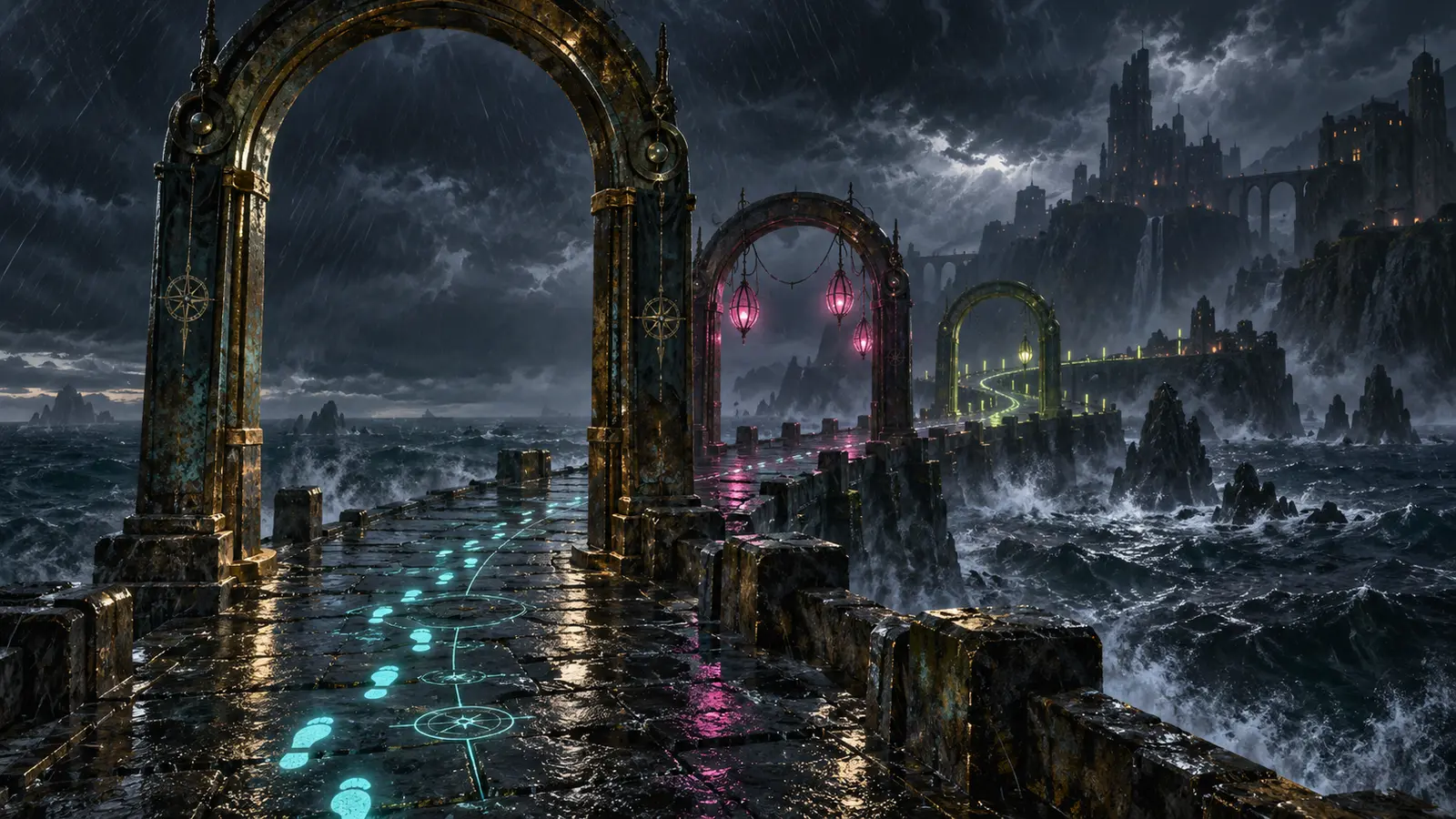
Today begins with an NES sword stroke hidden inside an empty patch of screen. It then follows an FFXIV dungeon as its scenery becomes narrative action, before listening to Chrono Trigger chords that move without promising the usual destination.
The feature belongs to Final Fantasy XIV. Arata Takahashi’s account of level design replaces a familiar production diagram—writers hand a story to artists who build a place—with something more collaborative and less orderly. The place is still helping to write the story while the player crosses it.
Final Fantasy: The black battlefield belongs to Odin’s blade
The black behind a monster in the Famicom version of Final Fantasy III looks like absence. It is actually working.
In Square Enix’s anniversary interview with system designer Hiromichi Tanaka, the origin begins with a problem of scale. Yoshitaka Amano’s monsters occupied one side of the battle screen; Koichi Ishii’s small character sprites occupied the other. The team wanted a monster-sized presence to appear on the players’ side too. Summons supplied that visual reversal, and Odin was the first one built.
Odin’s Zantetsuken needed to look as though it split an enemy across the middle. The solution came from somewhere that had nothing to do with role-playing games. Before Final Fantasy III, the team had made the racing game Rad Racer. To animate a road turning on a cathode-ray-tube display, its programmers shifted individual horizontal scanlines. Tanaka realized that the same technique could offset the upper and lower portions of a monster in opposite directions.
The trick created a constraint. The NES could not place a convenient independent layer behind the enemy. If the monster had been drawn over ordinary scenery, the scanline shift would have sliced and displaced the scenery too. The developers therefore kept the enemy’s portion of the battlefield black and confined the location graphics to the upper part of the screen.
That is an unusually satisfying explanation because it reverses what the eye assumes. The empty field was not a failure to decorate. It protected the illusion by giving the sword nothing else to cut.
Tanaka’s recollection also shows how a series acquires visual tradition. Odin’s horse came from an Amano illustration that happened to resemble what the team wanted. Zantetsuken itself was debated—some developers remembered Odin as a spear user. A scanline technique migrated from a racing road to a magic attack. None of those pieces began as an immutable franchise rule. Once assembled, they became an image later games could inherit: horse, blade, black space, and a screen made to separate at the strike.
Final Fantasy XIV: The dungeon writes while the party walks
“Level design” can sound like a synonym for adjusting difficulty. Arata Takahashi begins by correcting the noun. In the sense used by FFXIV’s developers, a level is a stage or scene. His team proposes and directs scenery across cities and overworld areas, but it also designs what occurs inside dungeons, raids, Gold Saucer attractions, and some seasonal events.
That description makes scenery sound less like a container. A dungeon is a sequence whose geometry, enemies, scripted events, and views control what the player learns and when. Takahashi’s example is Holminster Switch, the first dungeon in Shadowbringers.
Major spoilers · Final Fantasy XIV: ShadowbringersHolminster Switch environmental events, transformations, and the dungeon's emotional progressionReveal
The scenario establishes that sin eaters have attacked a village, but Takahashi says it does not prescribe every component of the dungeon. His level-design proposal turns that premise into three phases. In the forest, the party sees beasts assaulted and transformed. Emerging from the trees reveals the larger chaos. Villagers then flee through the playable space and are overtaken.
Takahashi assigns an emotional movement to those stages: witness, anger, powerlessness. Those are not lines delivered in a cutscene after the fighting stops. They are conditions produced by the order in which the player reaches places and by what the environment permits the player to see without permitting them to prevent it.
The distinction matters. A corridor can connect three enemy packs and still be only circulation. Holminster Switch uses progression itself as syntax. The forest restricts the view, the exit widens it, and the village supplies people whose movement gives the disaster a human scale. Each spatial change revises the meaning of the next battle.
Takahashi also identifies smaller authored events: sin eaters hatching from cocoons along the route and villagers running from the rear of the settlement. Such actions join combat and story at the point where a conventional production pipeline might divide them. The monsters are encounter material, moving scenery, and evidence about what is happening to the world.
The level designer does not create this alone. Takahashi describes conferring with the Event and Scenario teams about story and with the Monster team about battle. The useful detail is that collaboration occurs while the dungeon’s particular story is being invented. Level Design is not simply handed a finished script and asked to furnish the room.
The final sequence is therefore authored in several media at once. Scenario supplies the calamity. Layout controls the order of knowledge. Encounters make the party spend time inside it. Animation and monster behavior show changes that prose could only report. The player’s forward motion edits those contributions into a single experience.
The same interview shows that this way of thinking extends beyond a dramatic dungeon. When Patch 5.3 added flight to A Realm Reborn areas, Takahashi wanted the new freedom to reward more than faster travel. Team members made places where players could land and dismount, including the palms of a statue beneath Highbridge and elevated structures at Moraby Drydocks. A movement rule had changed, so the old scenery needed new destinations.
That work is easy to underestimate. Flight can convert roofs, masts, statues, and cliffs from distant composition into reachable ground. Every newly accessible surface creates questions: Can a character stand there? Should there be something to notice? Does the route connect regions in a way the original map never anticipated? The patch did not merely raise the camera. It changed which parts of the image had to become places.
Takahashi’s team sometimes travels farther still. He says Level Design created scenery and systems for Gold Saucer attractions such as Leap of Faith and The Slice Is Right. Air Force One required a new system because FFXIV had no existing mechanic that behaved like it. A group whose name suggests floors and walls can end up prototyping an arcade game.
The common responsibility is not architecture but experience in sequence. Where can the player go? What happens there? What becomes visible from that position? Which action must the game learn to support? Holminster Switch is the dramatic version of the work, but a landing spot and a carnival attraction expose the same principle. Space becomes a level when movement through it produces an event.
Seen this way, the authored unit is not the room but the encounter between a player and a place. A vista has to appear from somewhere. A transformation has to happen early enough to explain danger and late enough to be witnessed. A fleeing villager needs a route that reads amid combat. Even a tiny perch added for flight has to reward the curiosity that carried someone there. Level Design coordinates those meetings. Its raw materials may be terrain, monsters, effects, or a new rule, but its final medium is attention: what the player notices because the game arranged for them to arrive at precisely that moment.
That is why Takahashi’s description complicates the notion of environmental storytelling. The phrase often means static evidence: a ruined room, an abandoned tool, a detail from which the player reconstructs something that happened earlier. Holminster Switch uses the environment in the present tense. Its story is not waiting in the scenery to be inferred. It arrives on a route, at walking speed, while the player is still trying to reach it.
Beyond Final Fantasy: Harmony moves without going home
Functional harmony gives chords jobs. One feels settled. Another prepares tension. A third intensifies that tension and points back toward rest. Composers can complicate the route almost without limit, but the listener still senses that the music is going somewhere and that one arrival will feel like home.
In “Nonfunctional Harmony in Chrono Trigger”, 8-bit Music Theory listens for passages that loosen that itinerary. The video’s clearest example is “Secret of the Forest,” built largely on a two-chord alternation. The chords do not behave like a question and answer. Their extended notes create two contrasting fields of color, neither fully stable, and the small clash between them helps produce the track’s suspended atmosphere.
“A Strange Happening” makes the contrast harsher. Its two chords share less material and their roots sit a tritone apart, so the alternation feels disturbing rather than weightless. The important control is repetition. Two unfamiliar harmonies can become intelligible through return even when they never acquire the usual functions. The listener learns the terrain without being given a destination.
The video does not argue that the entire soundtrack abandons direction. Its more interesting claim is that Yasunori Mitsuda mixes functional and nonfunctional behavior. In the title music, initially disorienting changes eventually disclose a tonal center; when the strange motion returns, memory has altered what the ear expects. Elsewhere, melodies often emphasize the notes that differ between two harmonic fields instead of smoothing the transition with tones both chords share.
That last choice keeps the technique audible. A composer could conceal the seam. Mitsuda often lets the melody touch it.
8-bit Music Theory presents nonfunctional harmony as a mood-setting tool and warns that too many unrelated chords can become hard to follow. Chrono Trigger gains a further resonance from using uncertainty selectively. This is a game whose familiar places can reappear under different conditions and whose journeys repeatedly unsettle the meaning of arrival. The soundtrack does not need to encode time travel as a secret theory. It is enough that some of its harmony teaches the ear a related skill: move through change, recognize what returns, and do not assume every path owes you home.
Source trail
- Square Enix, “FINAL FANTASY III 30th Anniversary Special Interview Vol. 1”, page dated April 26, 2025 and identified there as an article originally published in 2020. Official interview with Hiromichi Tanaka.
- Square Enix, “FFXIV Backstage Investigators (No. 2): Lead Level Designer Arata Takahashi”, November 30, 2020.
- 8-bit Music Theory, “Nonfunctional Harmony in Chrono Trigger”, February 21, 2017. Full English auto-caption transcript reviewed; runtime 12:56.
- Square Enix Music, CHRONO TRIGGER Original Soundtrack Revival Disc, July 10, 2019. Official track listing and composition credits.