Save Point · A daily JRPG corner
Save Point: The Battle Menu Has a Body
Final Fantasy V leaves room for players who reject its jobs; FFXIV's Lodestone once trailed Eorzea by half a day; and Paladin's Quest maps a battle menu onto the body.
Approximately 11 minutes
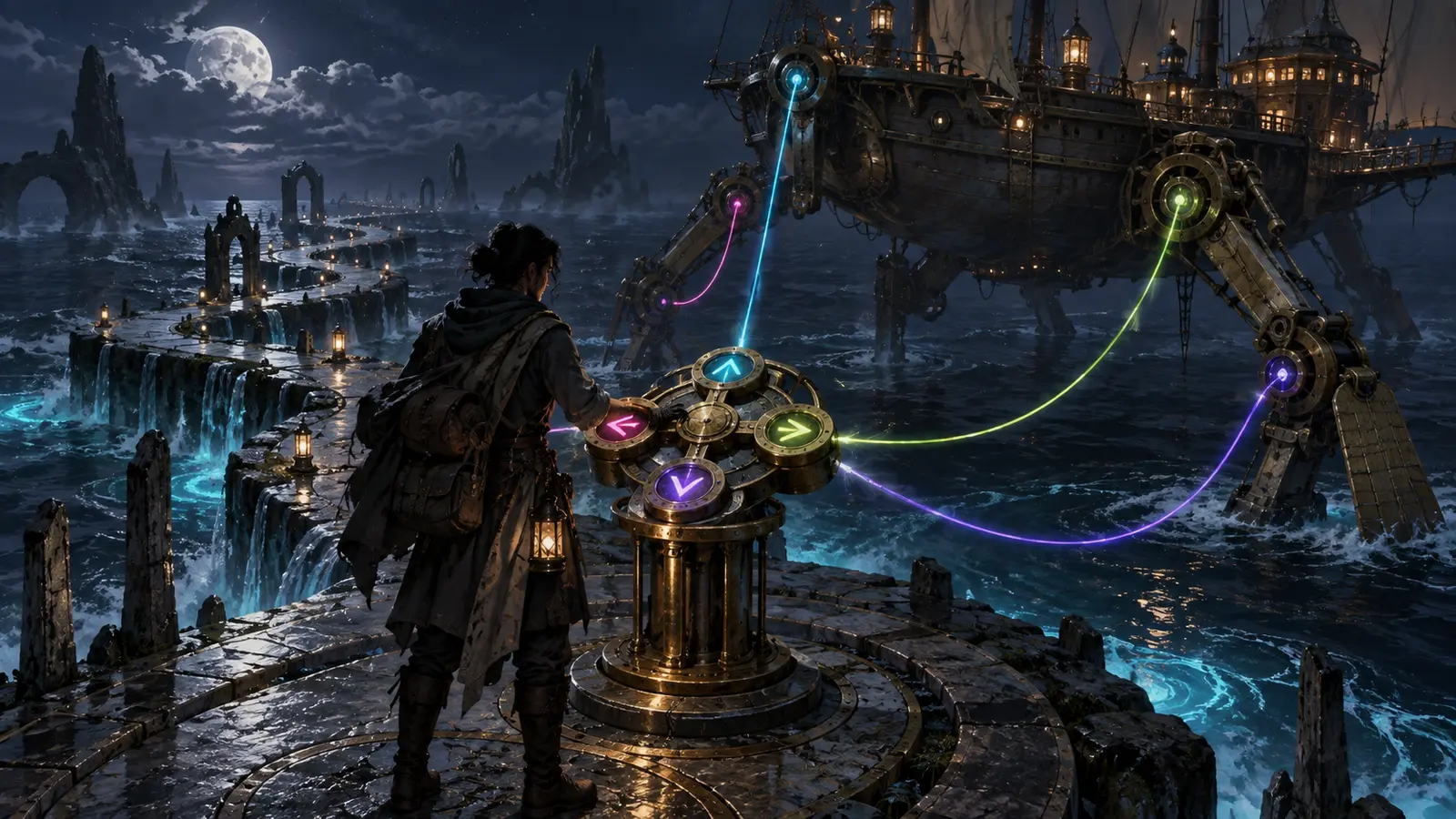
Today’s three discoveries concern what a system permits, what it remembers, and what it asks a hand to do. Final Fantasy V makes room for the player who declines its signature mechanic. FFXIV’s companion website reveals the work required to move one character between game and web. Paladin’s Quest turns a command menu into something closer to an anatomy lesson.
The feature belongs to that last game, a 1993 North American release better known in Japan as Lennus. Its combat interface is strange enough to challenge an assumption that thousands of ordinary RPG battles have trained into us: a menu may describe an action without feeling like part of it.
Final Fantasy: The job system permits refusal
Final Fantasy V is remembered as the game in which jobs became ingredients. A character can train as one class, learn a command or passive ability, and carry that piece into another class. The obvious way to honor such a system would be to demand mastery of its combinations.
Square’s developers said the game would also accept the opposite response.
In a translated 1992 interview, battle programmer Katsuhisa Higuchi recalls that people inside Square completed Final Fantasy V without changing jobs at all. Visual-scene designer Keizou Kokubo calls the player who picks one job and keeps it a valid way to play. Map designer Ikuya Dobashi adds that the game avoids the sort of boss restriction that had made a particular character necessary in Final Fantasy IV. Battle-graphics designer Hiroshi Takai is blunter: anyone uninterested in the job system can stay with the default job.
That latitude did not begin as an abstract doctrine. When the interviewer asks whether player freedom had been a goal from the start, director Hironobu Sakaguchi says the team was not especially preoccupied with “freedom.” He describes a more practical pleasure: putting many elements together and allowing the player to choose among them.
The distinction matters. A game can advertise freedom while quietly converting every option into homework. Final Fantasy V offers a large combinatorial space, but its developers did not treat failure to explore that space as incorrect play. The system rewards curiosity without requiring submission to its own complexity.
That is a demanding kind of balance. If every obstacle exists chiefly to prove the value of switching jobs, the choice becomes ceremonial: the menu offers many doors, but the encounter designer keeps handing out the correct key. The developers instead describe bosses that preserve room for party plans they did not prescribe. A player who explores can find efficiency and surprise. A player who abstains is asked to endure the consequences of a narrower toolkit, not a prohibition.
That makes the default job more than a tutorial state waiting to be discarded. It is an escape hatch from the designer’s favorite idea. By testing the game with people who refused to change jobs, Square tested whether abundance had become coercion. The famous mechanic remained optional at the scale that mattered most: the player could say no and still reach the end.
Final Fantasy XIV: A character page has to commute
Changing a coat in FFXIV is immediate. Seeing the same coat on a Lodestone character page was, at least in 2020, a small distributed-systems problem.
Web director Hiroyuki Takachi explained that FFXIV used one database server to relay game data and another to manage Lodestone data. Information shown on the website had to cross that boundary, then be converted and compiled for the web. A player’s equipment therefore existed in two public states for a while: current inside the game, older on the character page.
At the launch of A Realm Reborn, that difference could persist for more than half a day. Takachi says the team underestimated the incoming volume and was too optimistic about parts of the site’s design. By the December 2020 interview, the delay had been reduced to about an hour. That figure describes the system at the time of the interview; the source does not establish today’s synchronization time.
Another Lodestone feature exposed the maintenance cost in a different way. The Job Guide launched during Stormblood because revised actions were too numerous to explain comfortably in patch notes. Each action initially had to be updated on the website by hand. Every patch turned a useful reference page into a large clerical and quality-assurance task. The web team gradually automated the transfer, reaching an almost fully automated process by Patch 5.05.
Both stories concern the same hidden question: when should a web page be trusted as a representation of a live game? A character profile is a delayed snapshot, while the Job Guide is closer to published documentation. One requires a reliable stream of individual state changes; the other requires authoritative rules to arrive with a patch. The pages may look like neighboring parts of one site, but the work behind their accuracy is fundamentally different.
Players encounter the Lodestone as a website, but its difficult work begins where the website touches a changing game. A displayed level, equipment slot, or action description is a claim that two systems agree. Takachi’s history makes the delay legible: Eorzea did not simply extend into the browser. Its data had to be carried there, checked, and taught how to keep up.
Beyond Final Fantasy: The battle menu has a body
The North American manual for Paladin’s Quest reduces battle to four familiar verbs: SPELL, DEFEND, WEAPON, and RUN. A player chooses commands for the whole party, confirms the batch, and watches the round unfold. Once the answer is yes, the manual warns, nothing can be changed until the round ends.
The instructions become stranger one page earlier. The Battle Screen primarily uses the Control Pad. Six options occupy six directions: up, right, down-right, down, down-left, and left. The shoulder buttons, Start, and Select have no function. The game has taken a controller full of inputs and deliberately narrowed combat to a thumb moving around a small directional field.
Mind Behind Media uses Paladin’s Quest as an early example of a combat interface changing the feel of a system rather than merely reporting it. The video’s larger argument separates what the player sees from what the player experiences: an interface can be perfectly readable and still leave the action feeling remote. Memorable combat often shortens that distance.
Here the six-direction arrangement is also an outline of a character’s equipment. Attacks can come from the head, either hand, the body, the legs, or an item worn at the belt. A sword in the right hand and a shield in the left are no longer collapsed into one generic ATTACK command. Boots can become a kick. Headgear can become the selected means of striking. What a character wears changes the available verbs.
The arrangement also compresses two decisions that RPGs usually separate. The player does not first choose ATTACK and then open another list to choose the weapon. The first directional movement already identifies the bodily slot from which the action will originate. That is not necessarily quicker than a conventional menu, but it gives the opening input semantic weight. Before damage is calculated, the hand has already expressed an idea about how this particular combatant fights.
The video places this experiment beside later games that bind combat more tightly to physical input: directional combinations in Legend of Legaia, button sequences in Lisa: The Painful, and party members mapped to face buttons in Valkyrie Profile. Those comparisons support the creator’s thesis, but Paladin’s Quest remains the oddest case because the controller mapping and the fictional body share a geometry. Moving a thumb toward a direction selects a corresponding part of the adventurer.
That relationship is easy to mistake for novelty alone. The interface does more than produce an unusual first hour. It changes the meaning of equipment. In many role-playing games, a helmet contributes a defense number and then disappears beneath a menu category. Paladin’s Quest lets the same slot become an attack source. A piece of armor can protect, carry an effect, or answer the player’s next directional press.
The system is not pure immediacy. After making bodily choices, the player still confirms the party’s commands and waits for the round. Enemy selection can be broader than choosing one exact target. Mind Behind Media’s phrase “reducing the distance between input and action” is useful precisely because it does not promise to eliminate the distance. Paladin’s Quest keeps the deliberation of a command-driven RPG while making the act of entering commands less interchangeable with every other game.
That remaining pause creates an interesting tension. The directional press feels local and embodied, but the round still belongs to the party as a planned unit. The player composes several small physical intentions, reviews them, and only then releases the sequence. The interface is therefore neither an action-game gesture nor a list of abstract orders. It sits between them: intimate at the level of each command, strategic at the level of the turn.
The Japanese sequel, Lennus II, clarifies what the first experiment left obscure. Writing for Game Developer in 2013, Zack Wood notes that the sequel displays attack power for each body part. A player can finally see how much damage a pair of boots may do; some equipment adds special behavior, including footwear that ignores defense. The added numbers do not replace the bodily idea. They make it easier to reason about.
This also reveals the cost of unusual interfaces. A conventional ATTACK command arrives with decades of shared literacy. A player knows roughly what it means before the first battle. A six-direction body requires teaching, adaptation, and enough feedback to distinguish a meaningful choice from an arbitrary one. The original game embraces mystery; the sequel decides that one part of the mystery should become a statistic.
Mind Behind Media argues that presentation, mechanics, and interaction should reinforce one another. Paladin’s Quest supplies a particularly literal demonstration. The combatant is absent from the first-person battlefield view, yet the menu reconstructs that missing person under the player’s thumb. Head. Hands. Body. Legs. Belt. The character returns as a set of directions.
Most command boxes ask what an adventurer should do. This one first asks which part of the adventurer should do it.
Source trail
- Hironobu Sakaguchi and the Final Fantasy V development team, “Final Fantasy V – 1992 Developer Interview”, translated by shmuplations and published December 25, 2021 from interviews originally published in 1992.
- Square Enix, “FFXIV Backstage Investigators (No. 3): Web Director Hiroyuki Takachi”, December 28, 2020.
- Mind Behind Media, “Why Are Most RPG Combat Menus So BORING?”, June 23, 2026. Full English caption transcript retrieved and reviewed.
- Paladin’s Quest North American instruction manual, archived by the Internet Archive. The archive identifies the item as the English SNES manual; its OCR and scanned pages document the battle controls and command flow.
- Zack Wood, “The World of Lennus II: An Improvement over Paladin’s Quest?”, Game Developer, July 24, 2013.