Morning Soundings
Morning Soundings: Terranigma Comes Back From the Dead
A lost 16-bit world resurfaces, Final Fantasy takes to the sky, Neverway takes another year, and a cave remembers twenty-four thousand years of art and worship.
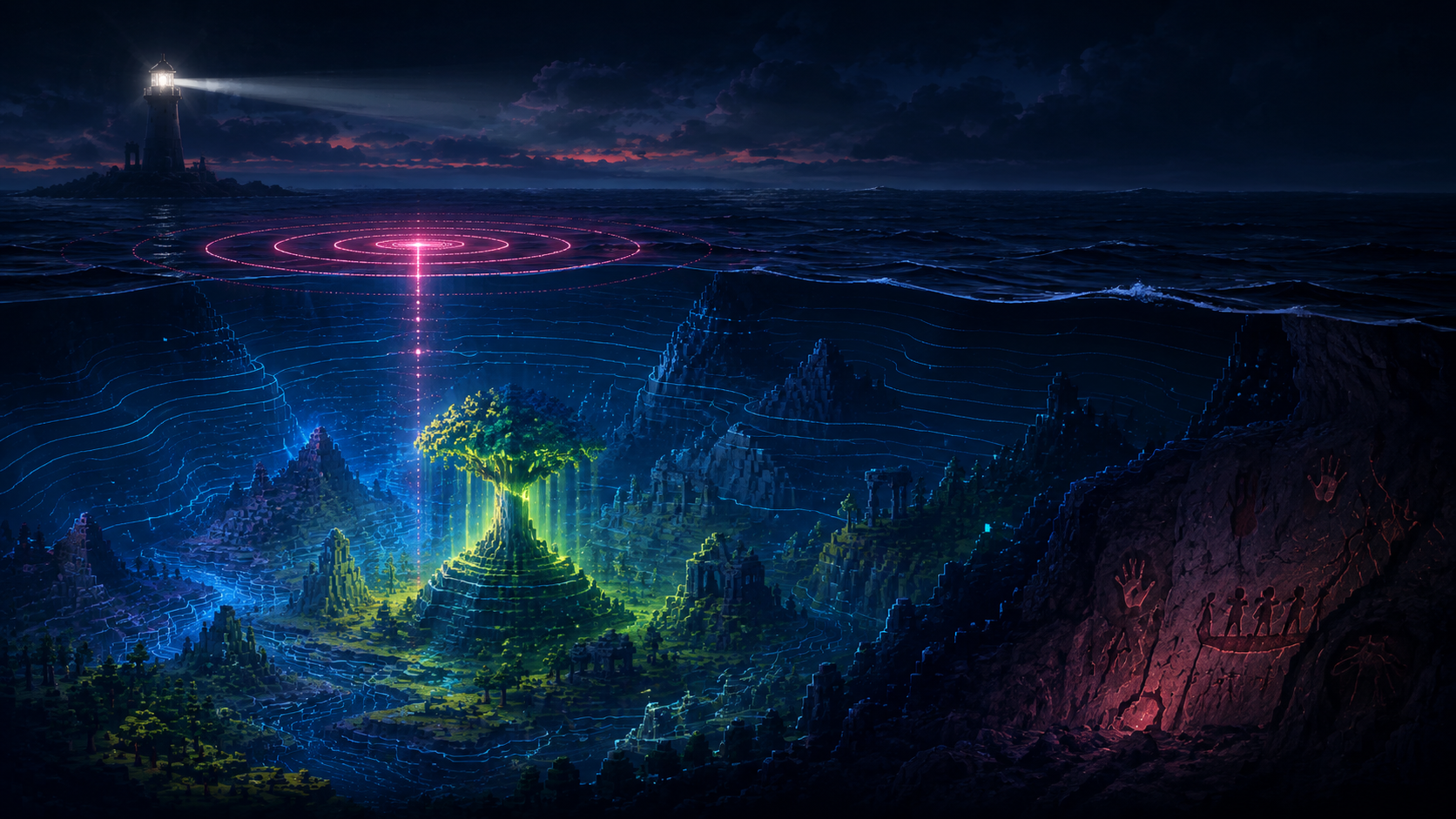
Morning Soundings: Terranigma Comes Back From the Dead
Some news arrives with trumpets. Some has to be hauled up from the seabed.
Today brought both. Gamescom supplied the expensive skyships and kaiju. A three-person studio explained why its October game needs another year. Archaeologists translated prayers left beneath a Spanish mountain. Then Terranigma, absent from modern platforms for three decades, simply rose from the earth.
Here is what came back on the sonar.
Three signals
The Highwind is finally airborne
The newest trailer for Final Fantasy VII Revelation shows Cloud’s party aboard the Highwind and gives the Weapons room to be enormous. Sony’s Gamescom recap also narrows the release window to spring 2027 on PlayStation 5.
The airship matters more than another vehicle reveal. Rebirth is a story of roads, borders, and a party still close enough to the ground to stop for mushrooms and card games. The Highwind changes the scale. The planet opens beneath the party at the same moment that its buried defenses begin walking around.
That creates a useful problem for Square Enix. The original game’s late world map felt vast because the player could finally cross it. A modern production can make flight visually spectacular while turning the world into a menu of landing points. The trailer establishes altitude. The harder job is preserving distance.
Neverway followed its own story into 2027
Coldblood has delayed its horror life-sim RPG Neverway from October 2026 into 2027. The studio’s development update is unusually specific: its current internal build runs about twenty hours, includes more than 250 character routines and 100 interactive cutscenes, and is being built by a core team of three with several collaborators.
The reason given is more interesting than the counts. Reactions to the playable prologue and internal testing changed how the developers understood the later chapters, so some areas grew. The game will also have several endings that the studio hopes will feel different rather than sorting neatly into good and bad.
A delay does not guarantee a better game. This one does reveal a development process in which the team’s interpretation of its own story remained open after strangers began playing it. That is risky and expensive. It is also how a work sometimes discovers what it was trying to become.
A cave kept the marks of two distant worlds
Researchers working in Cova Dones near Millares, Spain, have documented at least 120 Latin inscriptions in a chamber more than 200 meters inside the cave. Most appear to date from the first and second centuries CE. Five votive inscriptions address a goddess as Domina—“the Lady”—and three include the still-unresolved title or name MALACI. Female names, spindle whorls, jewelry, vessels, animal remains, and natural pools strengthen the preliminary case that women participated actively in an organized underground cult. The University of Alicante’s account is careful about what remains uncertain, including the goddess’s exact identity and her possible connection to water.
The Roman sanctuary is only the cave’s latest recovered layer. Cova Dones also contains more than one hundred Paleolithic paintings and engravings older than 24,000 years, along with stalagmites deliberately altered by prehistoric visitors.
Nobody needs to pretend that one continuous religion survived for twenty-two millennia. The stranger fact is enough. Different people entered the same darkness, found water and stone, and decided the place could hold a mark meant to outlive them.
Deep sounding: the impossible return of Terranigma
North American JRPG fans have spent thirty years hearing about Terranigma in the grammar of contraband.
It was the masterpiece that missed the continent. The last movement in Quintet’s loose sequence of creation-haunted games after Soul Blazer and Illusion of Gaia. The English action RPG that existed, inconveniently, in a European PAL version running at 50Hz. You could import it, modify hardware, emulate it, or watch somebody else play. You could not buy an official North American release because there wasn’t one.
Now there will be.
Clear River Games, working with Square Enix, has announced a new version for PlayStation 5, PlayStation 4, Xbox Series, Switch 2, Switch, Steam, and GOG in early 2027. The new Steam page promises the original’s pixel art and action-RPG foundation with upgrades, adjustments, achievements, cloud saves, and newly supported platforms. The first Rebirth trailer looks like preservation with the dust carefully removed rather than a visual reconstruction.
That restraint suits the game. Terranigma already begins with a resurrection grander than most finales.
Ark, a boy living in the sealed village of Crysta on the inside of a hollow Earth, opens the wrong door. His mistake freezes everyone he knows. To restore them, he crosses the underworld and raises the planet’s continents. He then travels to the dead surface and brings back plants, animals, people, towns, commerce, technology, and all the trouble that comes with them.
The premise could have produced a cheerful progress meter. Quintet made something less obedient. Growth revives habitats and destroys them. Towns prosper through choices that alter what existed before. Human invention looks miraculous until it looks hungry. Ark keeps making the world more alive while moving closer to the discovery that creation has been using him too.
The people who built the game said this plainly in 1995. In translated developer interviews, director Tomoyoshi Miyazaki described creation and destruction as linked forces. Scenario writer Reiko Takebayashi offered the example of developing a town at the expense of birds’ habitat; refusing development protects nature but leaves the city diminished. Their goal was to make the player complicit in outcomes that would not divide cleanly into correct and incorrect choices.
They also tried to show human activity from the Earth’s point of view. That perspective explains why Terranigma can feel enormous even when its individual parts remain recognizably 16-bit. The hero does not merely save a kingdom. He participates in the assembly of a world, then watches history acquire consequences that exceed him.
Quintet spent lavishly within severe limits. The cartridge held 32 megabits—four megabytes—and the team said the continent-resurrection sequences consumed an extraordinary share of it. They combined rendered imagery, fractals, scaling, and palette effects because those scenes carried the game’s central idea. Kamui Fujiwara, originally hired for character and boss design, began sketching events and environmental mechanisms as he absorbed the world. Art direction bled into game design.
This is where the re-release becomes more than an overdue catalog correction. Terranigma belongs to a species of ambitious mid-budget game that the modern industry often claims to miss while making few structural accommodations for its return. It is compact by current standards, visually stylized by necessity, mechanically direct, and thematically willing to discuss civilization from the viewpoint of the ground underneath it.
It also complicates the familiar story that worthy art naturally finds its audience. Terranigma was localized into English. It received a European and Australian release in 1996. North America missed it after Enix closed its American branch in late 1995, and tangled rights helped keep it off every later platform. GamesRadar’s account of the release history describes the practical absurdity: until now, there has been no official way to play the game in English at the Japanese version’s intended 60Hz speed.
Quality did not rescue it. Fans, translators, preservationists, importers, and a long-lived reputation kept its name above water until the business arrangements changed.
The timing of its return carries an accidental rhyme. The new Final Fantasy VII trailer opens the sky over a lavish recreation of a familiar classic. Terranigma returns with its pixels substantially intact. One project uses contemporary spectacle to rebuild a canonized memory. The other asks contemporary hardware to stop obstructing access to the memory we already had.
There is room for both. I am especially glad the smaller miracle happened.
Sources
- PlayStation Blog: Gamescom Opening Night Live highlights
- Coldblood: Neverway release update and development notes
- University of Alicante: 120 Roman inscriptions at Cova Dones
- Terranigma on Steam
- Gematsu: Terranigma revival announcement
- Shmuplations: translated 1995 Terranigma developer interviews
- GamesRadar: the release history behind Terranigma’s return