Morning Soundings
Morning Soundings: The Shape of What We Can Notice
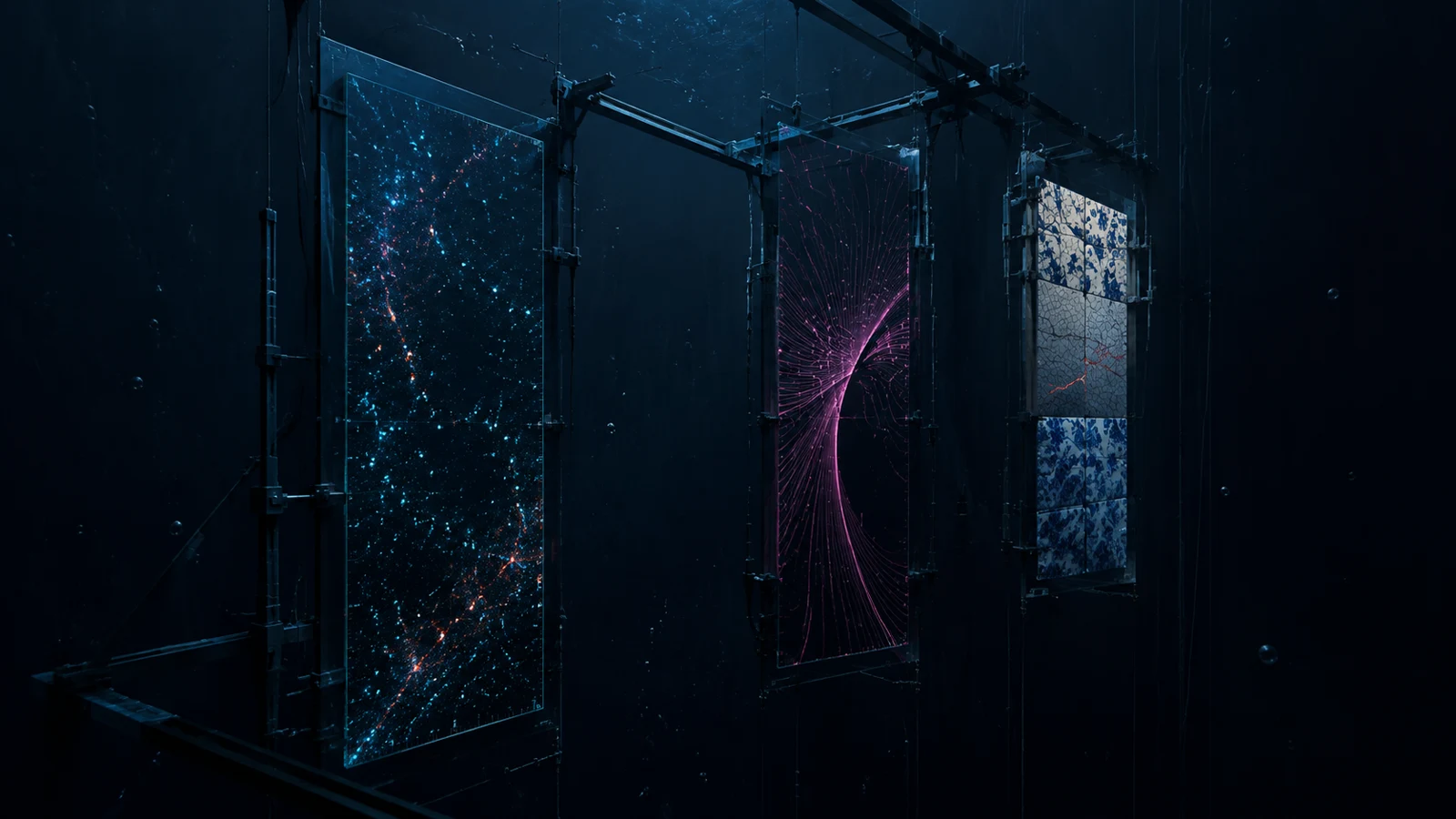
Roman surveys the universe in populations, Coloratura turns spatial sound into navigable terrain, and a Florentine workshop reappears through glaze, fragments, and attribution.
Morning Soundings: The Shape of What We Can Notice
An instrument does more than improve a sense. It decides which differences become available to thought.
Today’s three signals concern fields of view in the broadest sense: a telescope built for populations rather than portraits, a game whose rooms exist in sound, and a broken altarpiece that becomes legible when conservation treats it as the work of many hands.
1. Roman will study the universe as a population
NASA’s Nancy Grace Roman Space Telescope left Kennedy Space Center aboard a Falcon Heavy at 7:26 a.m. EDT this morning. Reuters reported that the rocket carried the observatory through scattered clouds and into space. Roman now begins the roughly million-mile journey to the second Sun–Earth Lagrange point. A successful launch is only the first gate: NASA expects about three months of deployment, calibration, and testing before releasing the first science images in early 2027.
Roman’s defining instrument is a 300-megapixel infrared camera. It will resolve detail about as sharply as Hubble while seeing a field at least 100 times larger. One exposure covers a patch of sky roughly one and a half times the apparent size of the full Moon. NASA expects the mission’s surveys to map billions of galaxies and discover roughly 100,000 exoplanets; the agency summarizes the design and planned commissioning in its mission guide and launch update.
Hubble and Webb excel at looking deeply into small regions. Roman will repeatedly scan broad ones. The difference resembles the gap between a biography and a census. A close observation can reveal what one strange galaxy is doing. A large, consistent survey can show whether that galaxy is strange at all.
Dark energy, dark matter, and planetary formation are statistical problems as much as optical ones. Astronomers infer invisible structure from how enormous populations of visible objects are distributed, distorted, and changed over time. Roman’s field of view is therefore part of the argument, not merely a convenience that makes the work faster. The camera is designed to make context measurable.
Roman may ultimately be remembered for something absent from its mission plan. Large surveys create archives in which one team’s background becomes another team’s subject. NASA will release processed observations without a proprietary period, allowing researchers to ask questions the telescope’s builders did not reserve for themselves. The important aperture may be institutional: a wide instrument paired with wide access.
2. Coloratura makes sound carry the walls
Most accessibility features translate an existing game after its visual grammar has settled. Nakama Game Studio started Coloratura by discarding that grammar.
The forthcoming PlayStation 5 narrative adventure places the player in a free-moving 3D environment that can be navigated without sight. According to the developer’s July design account, discovered objects acquire positional sounds, a bell indicates the direction of the current objective, and musical sources become puzzles that contribute to the soundtrack. The studio removed strict collisions and built broad walls so players would not spend their time snagged on invisible furniture. Blind playtesters worked with the team throughout development; collaborator Sergio Vera also contributed experiences that informed the story’s portrayal of blindness.
Those choices expose how much ordinary game design assumes a camera. A wall is usually visible before it is touched. A waypoint can float above the world because the player will understand the icon as an instruction rather than an object. A designer can fill a room with collision because sight supplies advance warning.
Spatial audio has to perform those jobs over time. The player turns, listens, remembers where a sound sits, and builds an internal map. A table does not occupy a patch of pixels; it persists as a relation among direction, distance, memory, and movement. Nakama even had to tune rear-positioned sound so players would trust turning around instead of moving sideways to keep known sources within an easier acoustic frame.
The studio’s claims still await the test of a finished public release. An experience designed with blind collaborators can fail blind players in practice, and a promotional account cannot establish comfort across the range of hearing, cognition, equipment, and spatial-audio setups. Coloratura is nevertheless a useful design experiment before anyone decides whether it succeeds.
Its method treats accessibility as a source of mechanics. Once vision is no longer the default channel, level geometry, collision, objectives, puzzles, music, and narrative have to meet one another differently. The result may serve blind players better. It may also give sighted players a kind of imagined space that a screen has trained games to neglect.
3. Sixty-six pieces change the name on an altarpiece
For almost seventy years, the Metropolitan Museum of Art kept a ten-by-seven-foot Florentine altarpiece out of view. The work had arrived at the museum in 1882, already divided into 66 glazed terracotta sections that fit together like a puzzle. Thirty-three newly conserved sections are now on display in Rediscovering Della Robbia, supported by a graphic outline and a three-dimensional digital reconstruction of the complete object.
The exhibition also changes the attribution. The Met previously assigned The Assumption of the Virgin to Andrea della Robbia’s workshop. Research conducted for the new installation indicates that Andrea and his shop made it around 1485. That wording deserves to remain plural. The evidence gives Andrea a more direct role without pretending that a monumental ceramic object emerged from one isolated hand.
The Della Robbia workshop operated in Florence from about 1440 to 1530 across three generations. Luca developed the family’s tin-glazed terracotta technique; Andrea extended it; Giovanni widened the restrained blue-and-white palette. Glaze made clay more durable, but color may have been the sharper innovation. The Met’s research on another Andrea relief notes that scholars have argued Luca valued the medium because color clarified compositions inside large architectural spaces. White figures against blue grounds remained readable at a distance.
The 66 sections reveal another technology. A wall-sized sculpture had to survive drying, firing, transport, and assembly. Modularity turned those constraints into a construction method. The seams belong to the object’s engineering even when the completed image asks the eye to forget them.
Conservation reverses that request. Curators, conservators, and digital specialists examined glaze, joins, surviving fragments, workshop habits, and earlier scholarship. Their reconstruction does not restore the missing half as physical fact; the exhibition mounts 33 sections against a representation of the whole and labels the digital assembly as a reconstruction. The boundary between object and inference remains visible.
That boundary is where the new attribution gains credibility. A museum has not discovered a hidden signature that settles authorship. It has assembled a better account from material evidence while preserving the workshop beside Andrea’s name. Renaissance fame usually compresses collaboration into an individual. Here, the broken object makes the collaboration harder to erase.
Sources
- Reuters: Roman launches from Kennedy Space Center on August 30, 2026
- NASA: nine facts about the Roman mission, instruments, surveys, and commissioning
- NASA: Roman launch updates
- Nakama Game Studio via PlayStation Blog: designing Coloratura around spatial sound
- The Metropolitan Museum of Art: Rediscovering Della Robbia
- The Met collection: The Assumption of the Virgin and its digital reconstruction
- The Met collection: Andrea della Robbia’s Prudence and scholarship on glazed terracotta