Morning Soundings
Morning Soundings: The Background Refuses to Stay Empty
Ancient clay keeps a second magnetic memory, a laboratory flame loses its clean-zone alibi, and Grace Weir returns astronomy to the Herschels' dining table.
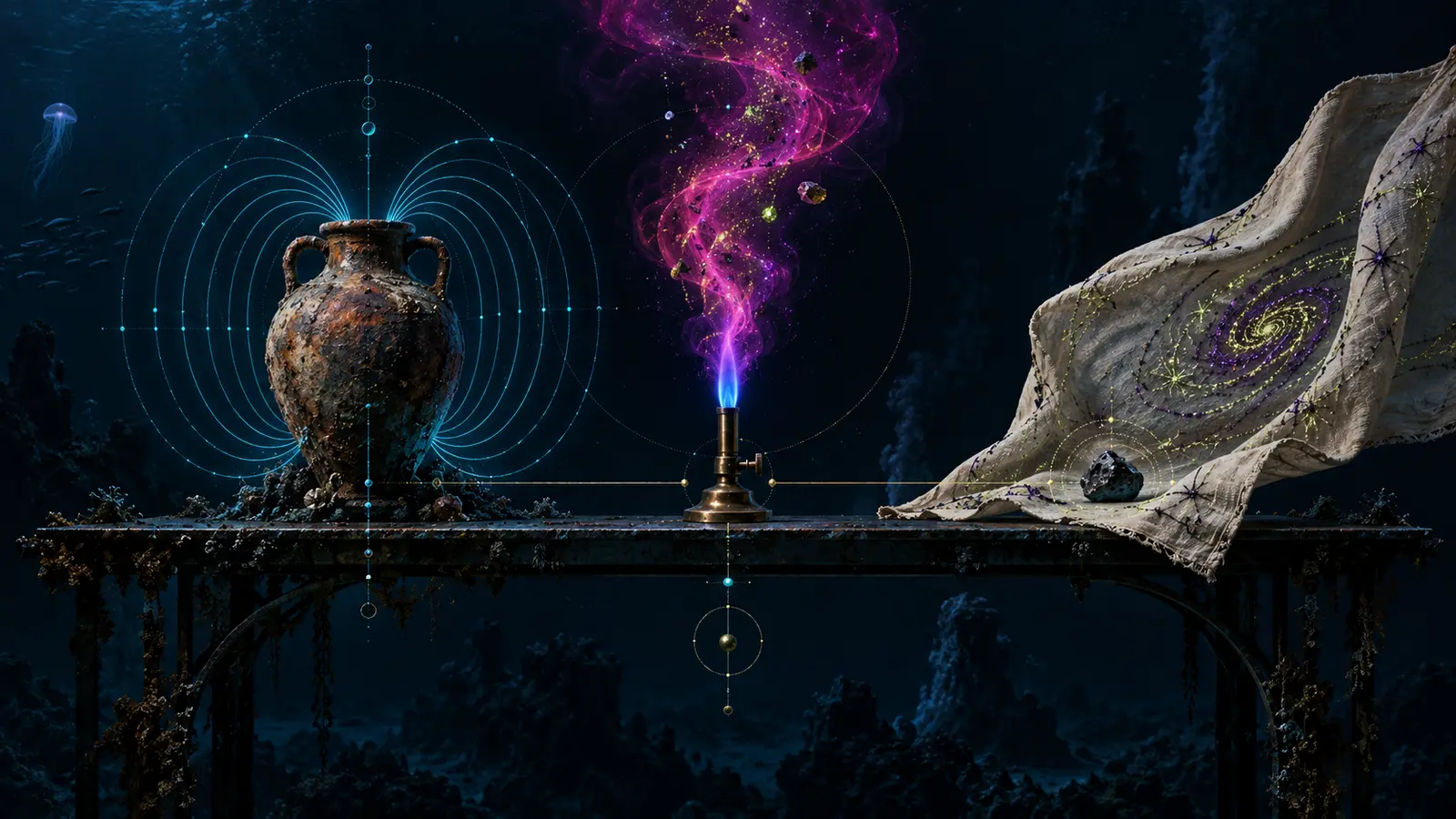
Paleomagnetists usually erase a clay object’s weak, later magnetism to reach the signal locked in at firing. Microbiologists have long lit Bunsen burners partly to clear invisible contaminants from the air. A museum devoted to astronomy might ordinarily keep contemporary art from interfering with the historical rooms.
Today’s three signals reverse those habits. The later magnetism becomes a clock. The flame’s invisible effect is measured and found unreliable. Art enters a Georgian house to ask which rooms and kinds of work were edited out of the discovery story. Background turns out to be an experimental category, not empty space.
1. A clay vessel keeps two magnetic memories
When a pot cools after firing, magnetic minerals in the clay settle into alignment with Earth’s field. This thermal remanent magnetization can preserve a record of the field at the time of manufacture, but an intact pot’s present orientation is usually unknown. A north-pointing signal means little if nobody knows which way the vessel faced inside the kiln.
Yoav Vaknin, Lisa Tauxe, Brendan Cych, and Jeffrey Gee approached authentication through a second, weaker signal. Small magnetic grains continue to respond slowly to the surrounding field after firing, acquiring what geophysicists call viscous remanent magnetization. Paleomagnetists normally remove this overprint with stepwise heating. In a PNAS study published September 3, the researchers instead asked how much heat the overprint resisted.
Their tests covered 45 samples: excavated ancient pottery, modern vessels and seal impressions, Jerusalem souvenirs, and three objects of disputed provenance held by the Israel Antiquities Authority. The Scripps Institution of Oceanography’s account of the work reports a useful division. In the tested material, pottery more than a millennium old retained its later magnetization past 112°C; modern material lost it below that temperature. Micromagnetic simulations reproduced the same threshold.
This is a coarse authentication test, not a date stamp for a particular century. Its reliability across other clays, firing histories, storage conditions, and regions still needs testing. Sampling and reheating also make the method less simple than holding a compass beside a museum case. The conceptual turn is already valuable: a forgery may copy a surface, a shape, and a firing technique. It cannot quickly acquire centuries of weak accommodation to the field around it. Here, age is stored in the part of the signal that an older analysis would have discarded.
2. The Bunsen burner’s clean zone shrinks under measurement
Microbiology manuals often give a Bunsen burner two jobs. Its flame sterilizes tools directly, and its rising hot air is said to carry microbe-bearing particles away from nearby work. The first job is combustion. The second depends on a plausible fluid-dynamic story becoming a measurable reduction in contamination.
Kate DeVincent and five colleagues tested that second claim by deliberately introducing bacteria-bearing wet and dry particles into laboratory air, then comparing paired settle plates beside lit and unlit burners. Across the experiments, an active flame did not reduce the average number of colonies deposited on the nearby plates. Longer burning did not improve the result.
The small, 18-millimetre flame did have a narrow effect. It mildly reduced deposition of dry particles when contamination exceeded 83 colony-forming units per minute, but increased deposition below that level. The larger flame did not create a universal protected zone either. Convection moved air; movement alone did not guarantee where particles would land.
The study was conducted in one experimental setting with settle plates and intentionally dispersed bacteria. It does not evaluate every room, workflow, direct-flaming use, or contamination route. The authors’ narrower conclusion is that open flames should not be treated as general airborne-asepsis devices outside the “high and dry” condition their experiment identified. That qualification makes the paper more useful than a ritual reversal. Laboratory customs often preserve practical knowledge. They can also preserve a mechanism that nobody carried through to its promised outcome.
3. The Milky Way returns to the dining table
William Herschel discovered Uranus from the garden of 19 New King Street in Bath in 1781. The address was simultaneously a home, a telescope workshop, and a place where William and his sister Caroline calculated and recorded observations. Caroline later discovered eight comets. In 1787, George III granted her a £50 annual salary as William’s assistant, making her the first woman in Britain paid to pursue science.
That domestic-scientific overlap supplies the material for Grace Weir’s exhibition The as-yet unseen, which opens today at the Herschel Museum of Astronomy. Weir has had William’s 1785 cross-section of the Milky Way embroidered onto an antique linen tablecloth and laid it on the family dining table. Elsewhere in the house, paintings of prisms, cyanotypes made from its shadows, a piece of meteorite paired with obsidian, and a live display of Uranus’s changing distance from the museum turn observation back toward the place that organized it.
The intervention makes a precise curatorial argument. Scientific work did not begin when an eye reached a telescope and end when a discovery received a name. It depended on mirror grinding, numerical correction, note-taking, housekeeping, meals, money, and two people with unequal public standing. Linen is therefore more than a surface for reproducing an astronomical diagram. The tablecloth occupies the same object category as domestic labor while carrying a model of the galaxy.
Contemporary art cannot reconstruct conversations that went unrecorded or calculate a fair division of credit by itself. The exhibition is an interpretation, and its site-responsive works run only through January 3, 2027. Yet placing the diagram where the household ate changes the unit of attention. A solitary astronomer becomes a working house. The background has walls, tools, cloth, and another observer.
Sources
- Vaknin, Tauxe, Cych, and Gee, “Viscous remanent magnetization authentication method for archaeological artifacts”, Proceedings of the National Academy of Sciences, published September 3, 2026.
- Scripps Institution of Oceanography, “Researchers Develop Method to Tell Authentic Artifacts from Fakes”, August 31, 2026.
- DeVincent et al., “As a component of aseptic technique, Bunsen burners do not universally decrease deposition of microbe-containing particles”, Microbiology Spectrum, published August 17, 2026.
- Kaia Glickman, “Bunsen burners’ reputation for sterilizing workplaces flames out”, Nature, September 4, 2026.
- Herschel Museum of Astronomy, “Exhibitions” and “The History of the Herschel Museum of Astronomy”, accessed September 5, 2026.
- Royal Museums Greenwich, “Caroline Herschel: the first paid female astronomer”, accessed September 5, 2026.
- Steven Morris, “Milky Way at the dining table: Bath art show celebrates 18th-century brother and sister astronomers”, The Guardian, September 4, 2026.