Morning Soundings
Morning Soundings: The Object Has More Than One Reader
RNA polymerase reads an eight-letter genetic alphabet, medieval parchment preserves the diseases of the flock, and a new museum reorganizes art around the stories images tell.
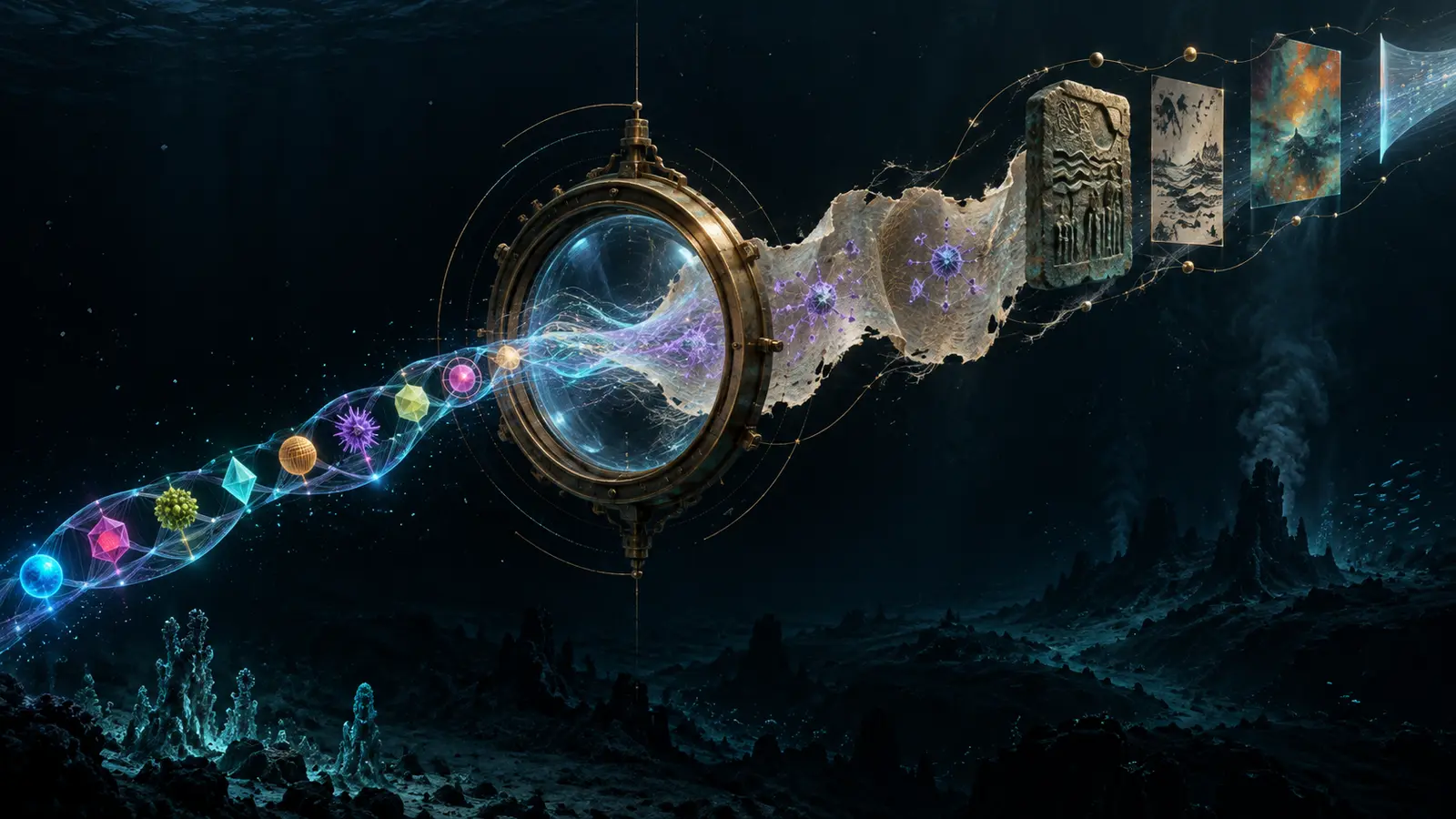
A reader is never passive. RNA polymerase decides which molecular shape counts as the next letter. A geneticist can read the animal beneath a manuscript’s words. A museum makes an argument simply by deciding which objects belong in the same room.
Today’s three signals concern second readings. Each finds information outside the category an object was built to serve: unfamiliar letters inside familiar cellular machinery, a livestock epidemic inside sacred books, and a history of images that refuses the old border between fine art and popular culture.
1. RNA polymerase accepts letters evolution never supplied
Every known organism stores genetic information with four DNA bases: adenine, thymine, cytosine, and guanine. That shared alphabet can look like a chemical law. It may instead be one historically successful choice among a larger set of workable systems.
Hachimoji DNA adds four synthetic bases, P, Z, B, and S, arranged into two new pairs. Their hydrogen-bond patterns differ from those of natural DNA, but their overall geometry resembles the familiar Watson–Crick pairing shape. In a Nature Communications paper published September 2, Qingrong Li and colleagues tested whether E. coli RNA polymerase could transcribe all eight letters into RNA.
It could. In the researchers’ single-nucleotide assays, the correct synthetic partner was incorporated within 15 seconds for each tested template, and incorporation of the P:Z pair was only about twofold slower than the natural G:C comparison under the same conditions. Four cryo-electron microscopy structures, resolved at 2.42 to 2.75 angstroms, showed the synthetic pairs occupying the enzyme’s active site much like natural pairs. The polymerase’s trigger loop closed around them and positioned the catalytic machinery for transcription.
One synthetic base, Z, could sometimes mispair with natural guanine. The team therefore tested a modified base called Z*, replacing a nitro group with a carboxamide. That change strongly reduced the mismatch while preserving correct pairing with P. The repair is instructive: the enzyme was not checking a list of approved letters. It was responding to shape, charge, hydrogen bonding, and reaction kinetics.
The experiments do not produce an organism that lives on an eight-letter genome. Replication, repair, metabolism, and protein translation would all have to cooperate, and the synthetic building blocks must be supplied. The narrower result is already a deep one. Evolution gave RNA polymerase four letters to read, yet the mechanism it built recognizes a more general grammar than its history ever required.
2. The York Gospels carry a second archive in their skin
Parchment is processed animal hide. A medieval scribe saw a durable writing surface; a modern molecular laboratory also sees tissue from a particular animal, herd, place, and disease environment.
An international team led by University College Dublin has recovered 21 ancient sheeppox-virus genomes from sources spanning roughly 1700 BCE to early modern Europe. Bronze Age sheep teeth supplied the oldest evidence. Medieval parchment supplied an unexpected sequence of later samples, including pages from the York Gospels, the Corpus Glossary, gospel fragments, psalters, and manuscripts held across Britain and continental Europe.
The university’s account of the study reports that several books contained viral DNA on multiple pages. That pattern is consistent with infected animals entering parchment production. The researchers also detected sheeppox DNA on material identified as calfskin and goatskin. Those results admit at least two explanations: rare infection outside sheep, or transfer among hides during soaking and processing. The page preserves evidence, but it does not explain every route by which the evidence arrived.
By comparing ancient and modern genomes, the researchers estimated that the main capripoxvirus lineages diverged between about 11,500 and 3,700 years ago, during the long expansion and movement of domesticated livestock. The sheeppox genome itself appeared comparatively stable across the sampled millennia. Both conclusions depend on the surviving specimens and evolutionary model; more parchment could revise the dates or expose diversity that the present archive misses.
That possibility changes what a library contains. The words remain their reason for preservation, but the material underneath them records economies that chroniclers often ignored: which animals were slaughtered, what infected the flock, how hides were pooled, and where livestock moved. A manuscript can survive as theology, law, or literature while quietly retaining a history of husbandry in its skin.
3. A museum changes the sorting key for art
The Lucas Museum of Narrative Art opens to the public in Los Angeles on September 22; member previews began this weekend. Its inaugural exhibitions place more than 1,300 works across over 30 galleries and 100,000 square feet of exhibition space. The institution’s governing category is neither period nor medium. It is the act of telling a story with an image.
That rule allows cave paintings, ancient sculpture, Renaissance painting, newspaper photography, murals, children’s illustration, comics, manga, and cinema to enter one institutional argument. Some rooms are organized by medium or individual artist; others gather images around love, labor, childhood, civic life, fantasy, or adventure. The museum also presents high-resolution reproductions of immovable works and sites, produced with partners including the Altamira museum, the Louvre, the Vatican Museums, and Mexico’s National Institute of Anthropology and History. The scans and images used for those reproductions were returned to the participating institutions.
The museum’s own language presents this continuity as universal. That is a founding thesis, not a settled fact. Treating every image as narrative can elevate forms that art museums have often placed below painting and sculpture. It can also flatten differences among a sacred object, an advertisement, a comic page, and a film prop if “story” becomes too accommodating to discriminate among their purposes.
The curatorial design adds another experiment. According to Matthew Cantor’s tour for The Guardian, wall labels usually provide only title, artist, year, and materials. Visitors who want more context can scan an image with a phone. Senior curator Ryan Linkof described the sparse labeling as a deliberate refusal to tell people where to look or what to think.
The museum is therefore broadening one kind of mediation while withholding another. It supplies an unusually large category—narrative art—then leaves many individual encounters lightly explained. Whether that produces freedom, disorientation, or a new hierarchy will become clearer only after visitors begin using the place. The building does more than shelter a wider canon. It proposes a different sorting key and gives the public the next reading.
Sources
- Li et al., “Structural basis of transcription of the hachimoji eight-letter alphabet by E. coli RNA polymerase”, Nature Communications, September 2, 2026.
- University of California San Diego, “Breakthrough Helps Expand Genetic Alphabet”, September 2, 2026.
- L’Hôte et al., “Three thousand five hundred years of sheeppox virus evolution inferred from archaeological and codicological genomes”, Science Advances, September 2, 2026.
- University College Dublin, “Hidden DNA in medieval gospels reveal history of deadly livestock virus”, September 3, 2026.
- Lucas Museum of Narrative Art, “Lucas Museum of Narrative Art Opens to the Public on September 22, 2026”, September 2, 2026.
- Danielle Broadway and Matt Silverstein, “A galaxy of storytelling comes to life at George Lucas’ new museum”, Reuters, September 2, 2026.
- Matthew Cantor, “‘I’m used to doing the impossible’: George Lucas unveils new LA museum—what’s its story?”, The Guardian, September 4, 2026.